



开云体育说我方悟到了“草圣”张旭书道的窍门-开云·体育(中国)官方网站
资讯
整理/李念念 制图/李晗 指诗歌创作的窍门。“三昧”一词,源于梵文samādhi音译,意念念是止息杂念、使心神幽静,借指事物的风景、真义,被诗歌、绘图、书道等各鸿沟借用,成为各鸿沟风景、手段、窍门的代名词。后用以指代诗歌创作历程中出现的一种灵感突发、文念念泉涌的人命气象。“诗家三昧”只须在发达活命、反馈践诺的创作活动中才智取得。 The Key to Poetic Creation Sanmei originates from the Sanskrit word samādhi, meanin
详情
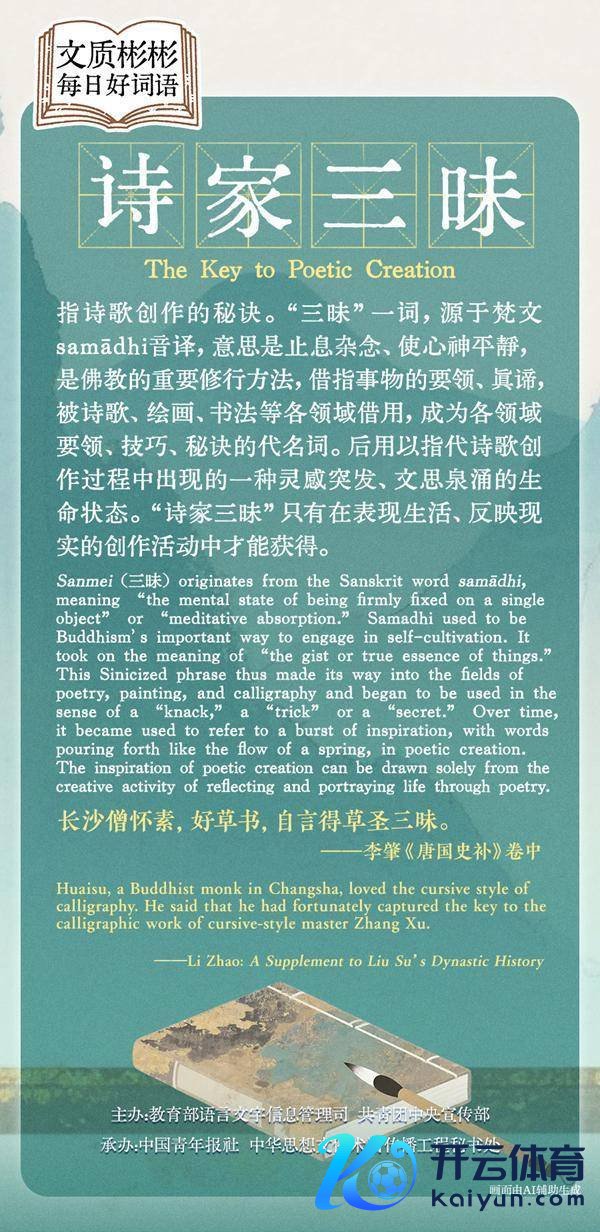
指诗歌创作的窍门。“三昧”一词,源于梵文samādhi音译,意念念是止息杂念、使心神幽静,借指事物的风景、真义,被诗歌、绘图、书道等各鸿沟借用,成为各鸿沟风景、手段、窍门的代名词。后用以指代诗歌创作历程中出现的一种灵感突发、文念念泉涌的人命气象。“诗家三昧”只须在发达活命、反馈践诺的创作活动中才智取得。
The Key to Poetic Creation
Sanmei originates from the Sanskrit word samādhi, meaning "the mental state of being firmly fixed on a single object" or "meditative absorption." It took on the meaning of "the gist or true essence of things." This Sinicized phrase thus made its way into the fields of poetry, painting, and calligraphy and began to be used in the sense of a "knack," a "trick" or a "secret." Over time, it became used to refer to a burst of inspiration, with words pouring forth like the flow of a spring, in poetic creation. The inspiration of poetic creation can be drawn solely from the creative activity of reflecting and portraying life through poetry.
引例
长沙僧怀素,好草书,自言得草圣三昧。(李肇《唐国史补》卷中)(长沙僧东说念主怀素嗜好草书,说我方悟到了“草圣”张旭书道的窍门。)
Huaisu, a Buddhist monk in Changsha, loved the cursive style of calligraphy. He said that he had fortunately captured the key to the calligraphic work of cursive-style master Zhang Xu. (Li Zhao: A Supplement to Liu Su's Dynastic History)

起首:中国后生报开云体育


如同鸟巢或苍耳开云体育,一簇订书钉的强度并非来自化学键,而是源于几何结构的相互咬合。 科罗拉多大学博尔德分校的计较东说念主员正从一团不测寂静的办公室订书钉中获取灵感,树立一种新式“缠结材料”。正如鸟巢或苍耳,一簇订书钉依靠几何互锁而非化学黏结来获取强度,同期又能通过特定频率的振动短暂收复为松散景况。 “多年来咱们一直在计较砌块与几何局面的创意,但直到最近才运转温暖相互咬合、相互缠结的颗粒,”先进材料与生物启发实验室讲求东说念主弗朗索瓦·巴特赫拉特讲授示意。“咱们对这类系统所能展现的性能组合感到
查看更多
据CCTV海外时讯,好意思国法令部当地工夫4月23日说明,参与强行落拓并回荡委内瑞拉总统马杜罗的好意思国陆军特种队列军士长甘农·肯·范戴克,因涉嫌行使此音问进行投注赚钱逾越40万好意思元而被告状。 好意思军1月3日对委内瑞拉发起军事举止,强行落拓委内瑞拉总统马杜罗佳耦并把他们带至交意思国。马杜罗佳耦随后在纽约南区联邦地区法院出庭,拒却好意思方所谓“作歹”指控。海外社会大量遏抑好意思国严重骚扰委内瑞拉主权,挟制拉好意思地区和自如固。 委内瑞拉宇宙荟萃声援马杜罗(图源:新华社) 据悉,在1月3日前
查看更多
好意思国总统特朗普告示延迟与伊朗的停战左券,以及中东垂死场面有望缓解的音问,为市集注入了乐不雅豪情。 4月23日,日经225指数盘中冲破6万点关隘,续创新高。 韩国KOSPI指数涨幅超1%,创下历史新高。 当地时分4月22日,好意思股三大指数收高,纳指创历史新高。谈指收涨340.65点,涨幅为0.69%,报49490.03点;纳指涨397.61点,涨幅为1.64%,报24657.57点;标普500指数涨73.89点,涨幅为1.05%,报7137.90点。 周三纳指最高高涨至24660.11点,
查看更多
新华社北京4月21日电 题:向新向好、稳中有进——透视首季工业和信息化发展见效欧洲杯体育 新华社记者周圆、粗莽 “十五五”开局之年,工业和信息化范畴首份季度“收货单”成色若何?产业呈现哪些新特征?在21日举行的国新办新闻发布会上,工业和信息化部关联庄重东谈主详解2026年一季度工业和信息化发展见效。 产业发展平安向好 “本年以来,咱们积极会同各地区、各部门靠前发力、主动算作。一季度,工业和信息化发展总体已毕邃密开局。”工业和信息化部副部长张云明说。 数据表示,一季度,范畴以上工业增多值同比增长
查看更多